
NQF4 Demo for approval
Ecology
Discover how Earth’s systems work together — from the six spheres to the great nutrient cycles that sustain all life. Understand the water, oxygen, carbon, and nitrogen cycles, ecological niches, and the limits that shape where organisms can survive.
Lecture & Materials
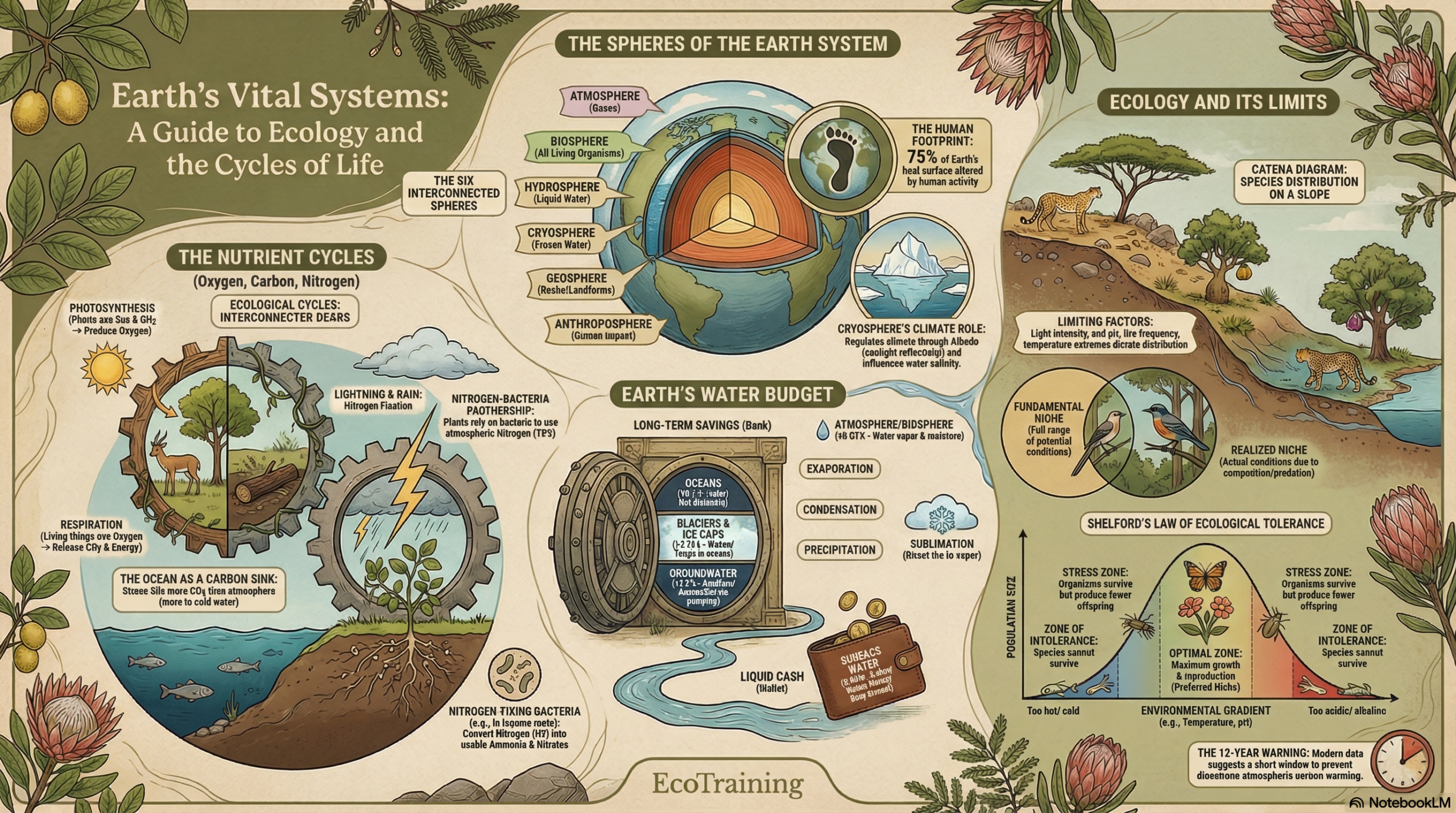
Live lecture recording, presentation slides & key learning outcomes🧠 Earth’s Systems — The Spheres, Cycles & Limits
This infographic summarises the six spheres of Earth, the four major biogeochemical cycles, ecological niches, and limiting factors covered in this module. Generated from our course source documents using NotebookLM.
🎥 Video Lesson Recording
Watch the full Module 5: Ecology lecture recording with Richard Davis. Use full-screen for the best viewing experience.
📋 Presentation Slides
Review the full slide deck from the live lecture below.
Lecture Content Overview
This module covers six major themes: the six spheres of Earth, the water cycle, the oxygen cycle, the carbon cycle, the nitrogen cycle, and ecological niches & limiting factors. Duration: approximately 120 minutes.
Only 0.01% of all water on Earth is surface freshwater in lakes, rivers, and marshes — that tiny fraction is what we interact with every day. The rest is saltwater (96.5%), frozen in glaciers, or locked in groundwater thousands of metres underground. Every raindrop is recycled: it has rained on dinosaurs, flowed through ancient civilisations, and will rain on your grandchildren. You are literally made of recycled water from billions of years of Earth history.
Everything connects: Geology creates soil → Soil determines water and nutrient availability → This drives which plants grow → Plants determine which animals thrive. Master the cycles in this module and you can explain any ecosystem to any guest. When you see a patch of acacia trees in otherwise grass-dominated savanna, you can tell guests: “Acacias are nitrogen-fixing legumes — they add nitrogen to the soil, which is why the soil here is richer and can support woody growth. Over time, they create islands of fertility.” That’s not just ecology; that’s storytelling that transforms a curiosity into understanding.
📖 Key Terminology
Examiners expect precise use of the correct terms. Make sure you can define each of these in your own words.
📚 Recommended Reading
The core references every serious field guide should know — these go deeper than any single lecture.
Enrichment & Resources
Videos, documentaries, research, organisations & apps to deepen your ecology knowledgeGo beyond the lecture — these resources will help you understand Earth’s life-support systems and explain to guests why ecosystems are as interconnected and finely balanced as they are.
🌿 EcoTraining in the Field
🎬 Recommended Videos
The Water Cycle
NASA’s comprehensive look at water movement
The Carbon Cycle
How carbon moves through Earth’s systems
Nitrogen Cycle Explained
Essential nutrient cycling for life
Ecological Niches
How organisms fit into ecosystems
📺 Must-Watch Documentaries
Our Planet
David Attenborough explores Earth’s ecosystems and the cascading impact of human activity on habitats and wildlife. Every episode connects directly to the ecological concepts in this module — water cycles, limiting factors, species niches, and ecosystem collapse.
Watch TrailerA Life on Our Planet
David Attenborough’s witness statement on the natural world, charting biodiversity loss and ecosystem collapse over his lifetime. A profound exploration of how human activity disrupts Earth’s cycles and niches.
Watch on NetflixKiss the Ground
Explores the critical connection between soil health, carbon sequestration, and climate change. Directly relevant to the carbon and nitrogen cycles and how human land management affects biogeochemical processes.
Watch FreeHome
Yann Arthus-Bertrand’s stunning aerial documentary showing Earth’s ecosystems and human impact from above. Visually powerful exploration of how ecosystems are distributed and how humans have disrupted them.
Watch on YouTube📚 Research & Further Reading
IPCC Climate Reports
The latest scientific assessments on climate change, carbon cycles, and human impact on Earth systems. Essential reading for understanding the science behind conservation and how carbon and other cycles are disrupted by human activity.
View ReportsNASA Earth Observatory
Satellite imagery and research on Earth’s atmosphere, water, carbon, and nitrogen cycles. Visual data and measurements that bring ecological cycles to life — see cloud formation, ocean currents, carbon dioxide concentrations in real time.
Explore Data📱 Useful Field Apps
Monitor Earth’s vital signs, document species, and understand ecological processes in real time.
Earth Now (NASA)
Real-time visualisation of Earth’s vital signs: CO2 levels, sea level rise, temperature anomalies. See the cycles in action.
Get AppiNaturalist
Document and identify species in the field. Build your understanding of biodiversity and ecological niches through citizen science and community identification.
Get AppWater Footprint Calculator
Calculate your personal water footprint and understand how the water cycle connects to your daily life and consumption patterns.
Use Tool🏢 Organisations & Communities
SANBI (South African National Biodiversity Institute)
South Africa’s authority on biodiversity. Research, conservation status assessments, and educational resources on local ecosystems and how ecological principles apply to South African conservation.
Visit SANBIWWF South Africa
Conservation organisation working to protect South Africa’s ecosystems. Resources on climate, water cycles, biodiversity, and how ecological limits shape conservation strategy.
Visit WWF South AfricaEarthwatch Institute
Citizen science expeditions and research programmes. Get involved in real ecological research and contribute to understanding Earth’s systems and human impact on cycles and niches.
Join ExpeditionsWhen guests ask why the landscape looks the way it does, you now have a complete explanation framework: “Here we see more grass because the water cycle brings 700mm of rain annually. But there — on that rocky ridge with poor soil — we see shrubs. Why? That dry slope limits water availability (limiting factor). The plants that survive here are shade-tolerant and drought-resistant. They occupy a realised niche determined by water, light, and competition. Elsewhere, where water is more available, grasslands can thrive instead.” That’s ecology applied to the landscape your guests can see.
Discussion & Community
Reflect on what you’ve learned and connect with fellow guidesGreat guides explain how Earth’s systems work. Use these prompts to practise applying ecological cycles and limiting factors to real landscapes — and share your insights with your classmates.
1 Cycle Spotter
Choose one of the four major cycles (water, oxygen, carbon, nitrogen) and find three real-world examples of it happening around you today. Share your observations. For example: “Water cycle: I saw dew on grass this morning (condensation), the sun evaporated it into the sky, and rain fell last night (precipitation).”
2 The Human Footprint
Which of the six Earth spheres do you think humans have impacted most severely? Make your case with specific examples from the lecture. How has human activity disrupted the natural cycles in that sphere?
3 Niche Detective
Pick any animal you’ve observed in the wild. Describe its ecological niche (what does it eat, where does it live, when is it active, what competes with it?). What do you think its fundamental niche might be versus its realised niche? What factors limit it?
4 The Carbon Conversation
A guest asks: “What’s the big deal about carbon dioxide?” Explain the carbon cycle and human disruption in 3-4 sentences using what you learned. Then explain why the nitrogen cycle is different (and why nitrogen is often limiting instead).